

Blog
State of the Vote: The History of Suppression in Hispanic/Latino Communities
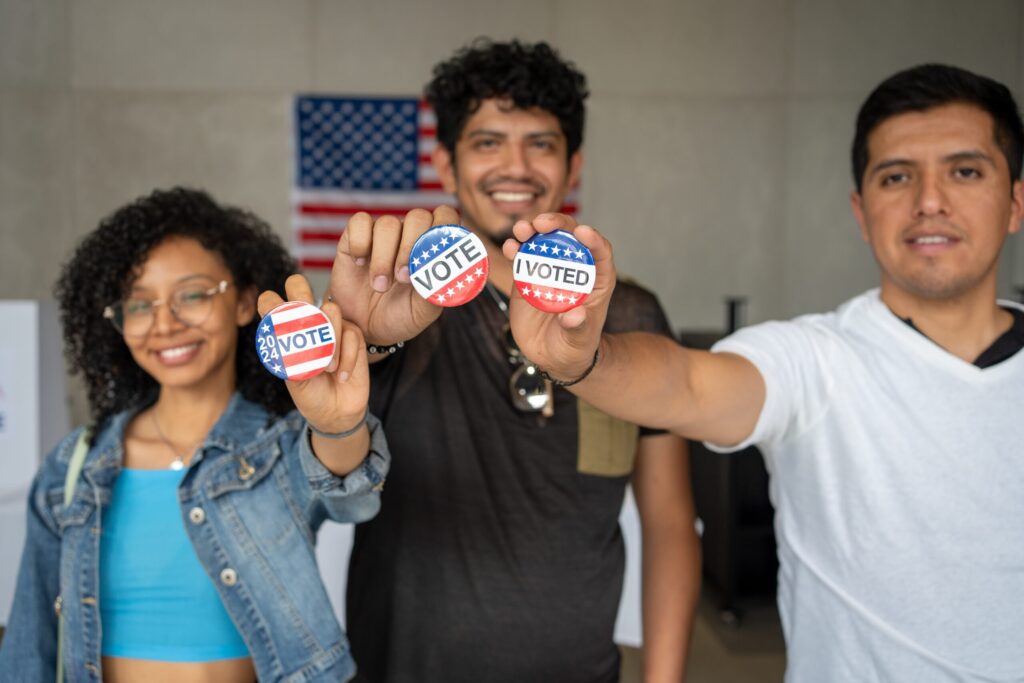
From September 15 through October 15th, the United States celebrates Hispanic/Latino Heritage Month. This is a time to honor and celebrate the vital contributions made to our nation by Hispanic and Latino citizens.
What is the difference between the terms “Hispanic” and “Latino”?
As defined by Britannica, “Hispanic” is a generally accepted, narrower term that includes people only from Spanish-speaking Latin America, including those countries/territories of the Caribbean or from Spain itself.
The site also defines “Latino” as a reference to those born in or with ancestry from Latin America (including Brazilians who speak Portuguese).
Data from the US Census illustrates that the Hispanic and Latino community makes up roughly 20% of the total US population and is expanding rapidly. This demographic growth directly impacts the makeup of our electorate. In 2024, 36.2 million Hispanic and Latino individuals were eligible to cast a ballot, representing an increase of roughly 4 million voters compared to the 2020’s 32.3 million.
Despite increasing suppressive efforts and racism targeting Hispanic and Latino communities, this expanding electorate continues to be an active and crucial bloc of participants in US democracy.
As highlighted by the League of Women Voters, “When young people register and vote, they don’t just add to totals; they carry family stories into public choices. A first ballot can reflect a parent’s sacrifices, a teacher’s guidance, and a community’s hopes. As more young people register and vote, their choices enter the ballot box and become part of public life.” By supporting civic engagement across Hispanic and Latino communities to get and stay engaged, we can encourage a more representative, equitable democratic system.
Throughout this Hispanic/Latino Heritage Month, we must recognize the enduring legacy of resilience within this community and let it empower our collective action against all forms of suppression.
Suppression Today: How Immigration Policy, Education Rollbacks, and Hate Crimes Target Hispanic/Latino Communities
“…The president and this administration [have] provided the space [and] the opportunity for people to air or take action specifically against immigrants. It doesn’t matter if they’re undocumented immigrants or if they’re legal citizens; this period of Latino hatred should be concerning for everyone.” – Juan Proaño, CEO of the League of United Latin American Citizens (LULAC)
The current administration has positioned the marginalization of the Hispanic and Latino community as a central component of the President’s prior campaigns, his administrations, and his ongoing political legacy. However, these divisive strategies and xenophobic tactics are far from original; they draw directly from a long-standing historical playbook used to suppress marginalized communities throughout US history.
Explore how these suppressive strategies have affected various marginalized groups here:
The divisive rhetoric pushed by MAGA Republicans has impacted the Hispanic and Latino communities significantly in several key areas:
On Immigration
- In February 2026, over 68,000 people were held in US Immigration and Customs Enforcement (ICE) detention, a 75% increase from early 2025.
- In 2025, at least 32 people died while being held in ICE custody, marking the deadliest year since 2004.
- A February 2026 report noted that the number of people held in ICE detention with no criminal record has risen by 25-fold since the President’s 2025 inauguration (from 950 individuals to 24,500 individuals).
- Between October 2025 and February 2026, more than 4,400 of these cases were already ruled illegal.
On Education
In the 2023 Supreme Court Case Students for Fair Admissions v. President and Fellows of Harvard College, the court ruled that colleges and universities may no longer use race as a factor in their admissions process. Since then:
- Latino enrollment at elite academic institutions has fallen sharply
- Roughly $350 million in grants for Hispanic-Serving Institutions have been cancelled, closing off a critical alternative financial pathway for students in need.
- 6.3 million US children in mixed-status families face fear and instability, leading to measurable declines in school attendance.
- In the first month of President Trump’s second term, school absences in California’s Central Valley rose over 20 percent amid increased federal threats.
On Race-based Violence
A report by the California Association of Human Relations Organizations (CAHRO), using FBI data, illustrated that the number of incidents labeled as “anti-Latino hate crime incidents” increased by 18% nationwide (from 858 incidents in 2024 to 1,014 incidents in 2025).
- In California alone, hate crime incidents against Latinos jumped 14.8% (from 209 in 2024 to 240 in 2025).
- These numbers marked an all-time high for the number of such incidents against Latinos since the FBI first started officially tracking hate crimes in 1991.
- The increasing number of incidents coincides with an increased focus on immigration enforcement by both local and national politicians.
- These discussions have largely centered on Latinos, and the demographic has been targeted by ICE raids.
The Continued Fight for Equity: From the Voting Rights Act to Shelby County and Callais
Though there is a continued history of efforts designed to undermine marginalized US citizens, the Hispanic and Latino communities have been at the forefront of the fight against suppression.
Following the Voting Rights Act of 1965, Hispanic and Latino advocates partnered with Black lawmakers to advocate for measures designed to dismantle barriers set against non-English-speaking voters. Passed in 1975, these reforms required state and local jurisdictions to offer multilingual voting materials and ballots in areas with significant populations of non-English-speaking citizens.
For decades, these safeguards included a vital preclearance mechanism that required jurisdictions with a history of racial discrimination to secure federal approval before changing voting laws. In 2013, the Supreme Court effectively gutted the Act’s preclearance requirement with its ruling on Shelby County v. Holder, enabling multiple states to enact voting restrictions that target communities of color.
Earlier this year, the Supreme Court ruled in Louisiana v. Callais that race-conscious redistricting remedies violate equal protection. The ruling also struck down the remaining Voting Rights Act protections.
To learn more about the detrimental effects of Shelby County v. Holder and Louisiana v. Callais, read our complete breakdown here.
Remaining engaged in the democratic process remains one of our most powerful tools to combat suppression. As the fight continues, this Hispanic/Latino Heritage Month reminds us of the critical need to stay involved in defending every voice in our nation.
Civitech stands in solidarity with Hispanic and Latino communities against systemic assaults on their rights and existence. So long as there are obstacles preventing equitable representation and full democratic participation, we will continue advocating for lasting change.
Civitech develops technology and data infrastructure to empower progressive political organizations, civic engagement initiatives, and voter registration campaigns.
Want to learn more about how to recognize and fight against voter suppression? Visit our resource here: https://civitech.io/voter-suppression/.